Press Release
Ship Finance - helping the industry navigate through increasingly uncertain waters
09 February 2026 | Grosvenor House, Dubai

SFTC 2026 Draws Overwhelming Industry Participation as Decarbonisation and Capital Innovation Take Centre Stage in Dubai
February 2026
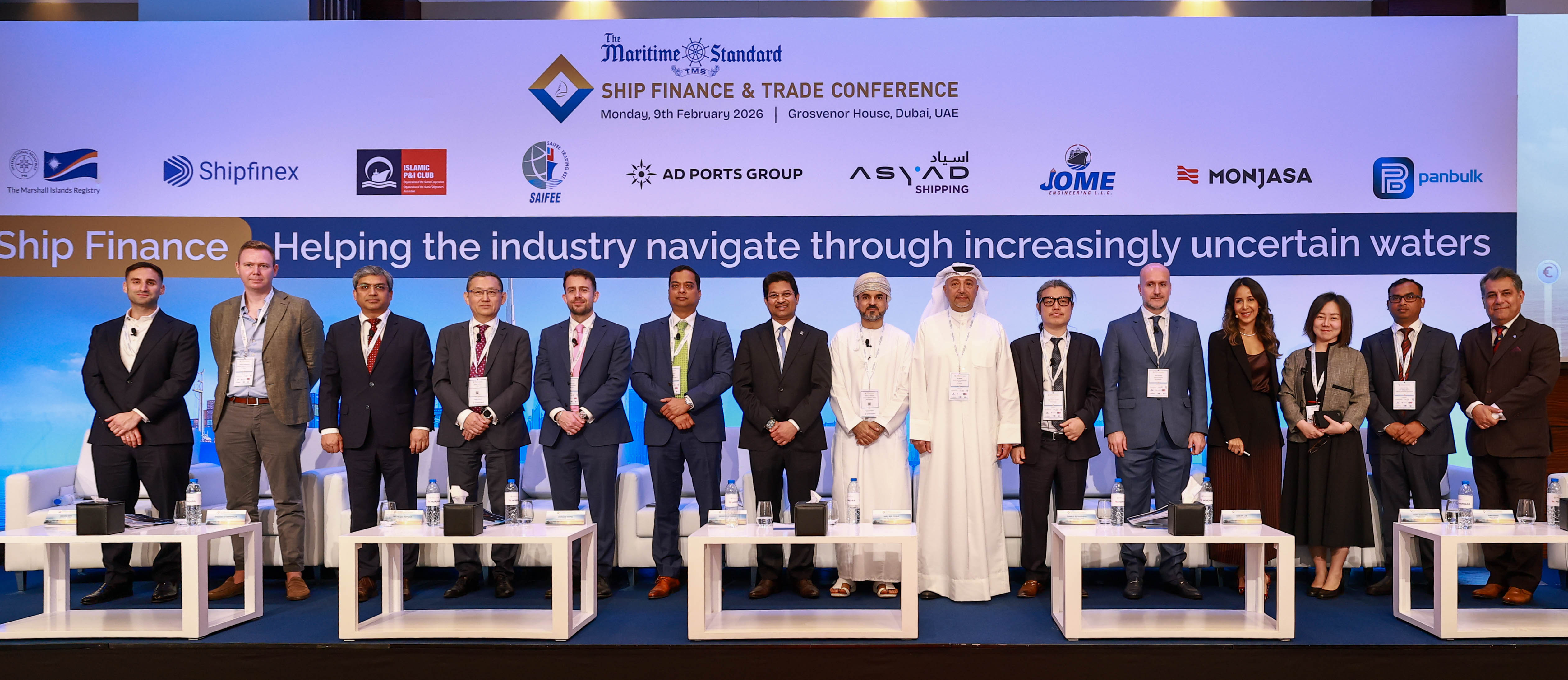
The TMS Ship Finance and Trade Conference 2026 (SFTC 2026) concluded successfully on 9 February at Grosvenor House, Dubai. Held under the theme “Ship Finance - helping the industry navigate through increasingly uncertain waters,” the event attracted overwhelming participation from shipowners, financiers, regulators, registries, technology providers, and service companies. Delegates from across the global maritime, finance, and trade sectors came together to discuss the challenges of market volatility, emerging financing models, and the accelerating transition to lower-carbon shipping.
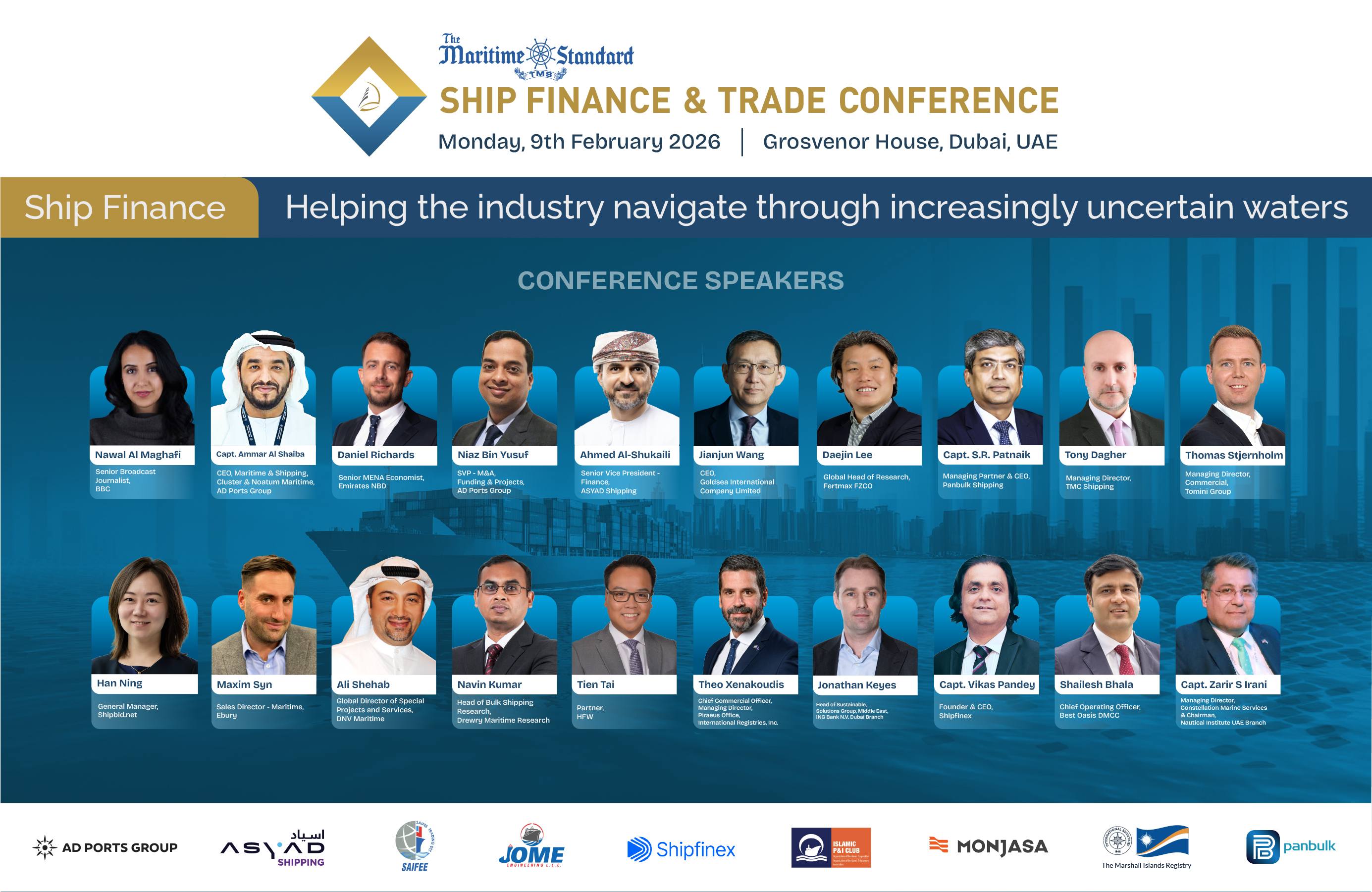
The conference was opened with a welcome address by Nawal Al Maghafi, Senior Broadcast Journalist, BBC, who set the stage for the day’s discussions on resilience, regulation, and the evolving landscape of ship finance. She emphasised the need for cross-sector collaboration and forward-looking strategies to ensure the shipping industry remains commercially resilient while meeting decarbonisation targets.
SFTC 2026 featured two core sessions that examined both immediate financial challenges and long-term strategies to support sustainable shipping. Session 1, “Financial Strategies in a Volatile World,” explored how market cycles, asset values, and geopolitical uncertainties shape investment and financing decisions.
Niaz Bin Yusuf, Senior Vice President of M&A, Funding and Projects at AD Ports Group, highlighted capital deployment strategies that balance operational needs with financial prudence. Daniel Richards, Senior Economist at Emirates NBD, shared insights into macroeconomic trends in the MENA region, including inflationary pressures, interest rate movements, and trade flows, and their implications for shipping and financial markets.
Ahmed Al-Shukaili, Senior Vice President of Finance at ASYAD Shipping, emphasised the importance of financial discipline and strategic capital planning to navigate periods of uncertainty. Jianjun (JJ) Wang, CEO of Goldsea International, addressed newbuilding strategies and financing options, highlighting how owners can optimise fleet renewal in the context of rising capital costs and regulatory expectations. Daejin Lee, Global Research Head at Fertmax FZO, explored data-driven forecasting and its role in identifying market cycles, enabling more informed investment decisions.
Capt. S.R. Patnaik, Managing Partner and CEO of Panbulk Shipping, discussed aligning commercial, operational, and chartering strategies to enhance financial resilience. Tony Dagher, Managing Director of TMC Shipping, and Thomas Stjernholm, Managing Director at Tomini Group, provided perspectives on asset trading, risk management, and capital deployment in volatile markets. Han Ning, General Manager at ShipBid.Net, highlighted how asset valuation and second-hand market dynamics influence investment decisions. Maxim Syn, Sales Director – Maritime at Ebury, rounded off the session by detailing currency risk management and treasury strategies, emphasising the importance of hedging and operational efficiency in cross-border transactions.
Session 2, “Developing Financial Tools to Sustain Support for the Green Transition,” explored the financing mechanisms and investment structures required to accelerate maritime decarbonisation. Navin Kumar, Director at Drewry Maritime Research, examined asset values, residual risk, and financing considerations in a market transitioning to alternative fuels and low-carbon technologies. He highlighted that fleet renewal decisions and financing terms are increasingly influenced by ESG considerations and regulatory compliance.
Tien Tai, Partner at HFW, discussed legal and financing structures that can support sustainable shipping investments. He emphasised the importance of contractual clarity, risk allocation, and multi-stakeholder approaches to reduce uncertainty in financing low-carbon projects.
Theo Xenakoudis, Chief Commercial Officer, Managing Director, Piraeus office, International Registries, Inc, outlined the role of flag states in supporting sustainable fleet growth. He noted that incentives, certifications, and technical support from registries can accelerate adoption of clean technologies and attract investment, while ensuring regulatory compliance and operational safety.
Capt. Vikas Pandey, Founder and CEO of ShipFinex, introduced tokenisation and digital finance as tools to broaden access to capital for sustainable shipping projects. He explained how vessel-level SPVs and blockchain-based governance can enhance transparency, facilitate secondary markets, and reduce barriers to institutional and retail investment.
Shailesh Bhala, Chief Operating Officer of Best Oasis Limited, highlighted perspectives from banking and shipowning on financing the green transition. He emphasised the need for innovative green instruments, sustainability-linked loans, and transition finance to make decarbonisation bankable.
Capt. Zarir S. Irani, Managing Director of Constellation Marine Services and Chairman of the Nautical Institute UAE Branch, discussed technical, regulatory, and operational considerations in financing sustainable shipping. He stressed that fuel choice and investment in alternative technologies must balance cost, availability, safety, and compliance, and that early adopters of cleaner fuels can secure asset value protection and operational flexibility.
The conference concluded with a shared view that shipping’s decarbonisation pathway depends not only on regulatory frameworks but also on practical financial mechanisms that improve bankability, manage risk, and mobilise capital at scale. Speakers emphasised the critical role of collaboration across the maritime value chain, including shipowners, charterers, cargo owners, financial institutions, technology providers, and regulators, to create conditions that support long-term investment in lower-carbon solutions.
Participants noted that no single stakeholder can deliver the transition in isolation. Coordinated approaches to financing, risk sharing, and policy implementation will be essential to maintaining commercial viability during the transition period. Discussions also highlighted that innovative instruments, digital finance, and ESG-linked investment frameworks are increasingly central to shipping’s financial ecosystem.
SFTC 2026 reinforced a growing industry consensus that sustained dialogue, pragmatic financial tools, and cross-sector collaboration are key to delivering a resilient, competitive, and decarbonised maritime sector. Delegates concluded that by combining technical innovation, regulatory alignment, and financial ingenuity, the industry can navigate market uncertainty while driving meaningful progress toward net-zero shipping.
Trevor Pereira, Managing Director of The Maritime Standard, welcomed the strong turnout, noting the exceptional line-up of speakers and the depth of discussions that made SFTC 2026 a highly successful and forward-looking event.
Related News
Global Maritime Leaders to Speak at TMS Ship Finan...
February 2026
Dubai, UAE. The Maritime Standard Ship Finance and Trade Conference 2026 will take place on 9 February 2026 at Grosvenor...